Jack-up barge preload: How leg penetration and punch-through risk are managed
Published on October 4, 2026 by Famous Dredging Corporation

Preloading looks like dead time on a job. The barge sits there while ballast pumps run, nothing visible happens on deck, and a crew under schedule pressure can start wondering why it can’t just skip ahead to jacking up. Skip it, and the first sign of trouble shows up with the deck fully loaded instead of empty, which is exactly the wrong time to find out a leg can’t hold.
This guide explains what preload actually does, how the process runs in practice, and how technicians read the warning signs of punch-through before it becomes a real incident. It follows on from our guide on how a jack-up barge works, which covers the jacking sequence preload sits inside.
What preload is actually for
Preload is a deliberate test. Before a jack-up barge commits to carrying its full working load, the crew ballasts the hull to simulate a load heavier than anything the job will put on the legs, and holds that load while watching how far each leg penetrates the seabed. If a leg is going to fail under load, preload is designed to make that happen now, at low air gap with the deck still empty, rather than later with equipment and personnel on board.
The logic is simple even though the engineering behind it isn’t. A soil layer that looks adequate on a general site survey can still hide a weaker layer underneath, and the only reliable way to find that out is to actually load the leg and watch what happens.
Why soil conditions decide everything
The same barge, same legs, same spud cans will preload completely differently depending on what’s under the water. Dense sand resists penetration from the start, so legs tend to stop early and the load-penetration curve flattens quickly. Soft clay offers much less initial resistance, so legs sink further before reaching a layer firm enough to bear the load, and that deeper penetration is often normal rather than a warning sign, provided it happens at a steady, predictable rate.
The dangerous case is layered soil. A firm sand or crust layer sitting over much softer clay can support a leg at low load, then fail suddenly once the load during preload exceeds what that thin crust layer can carry. The leg punches through the crust and drops rapidly into the softer layer below. This is precisely why preload exists and why it has to be run at a load genuinely higher than anything expected during the job, not just the expected load itself.
How the preload sequence runs in practice
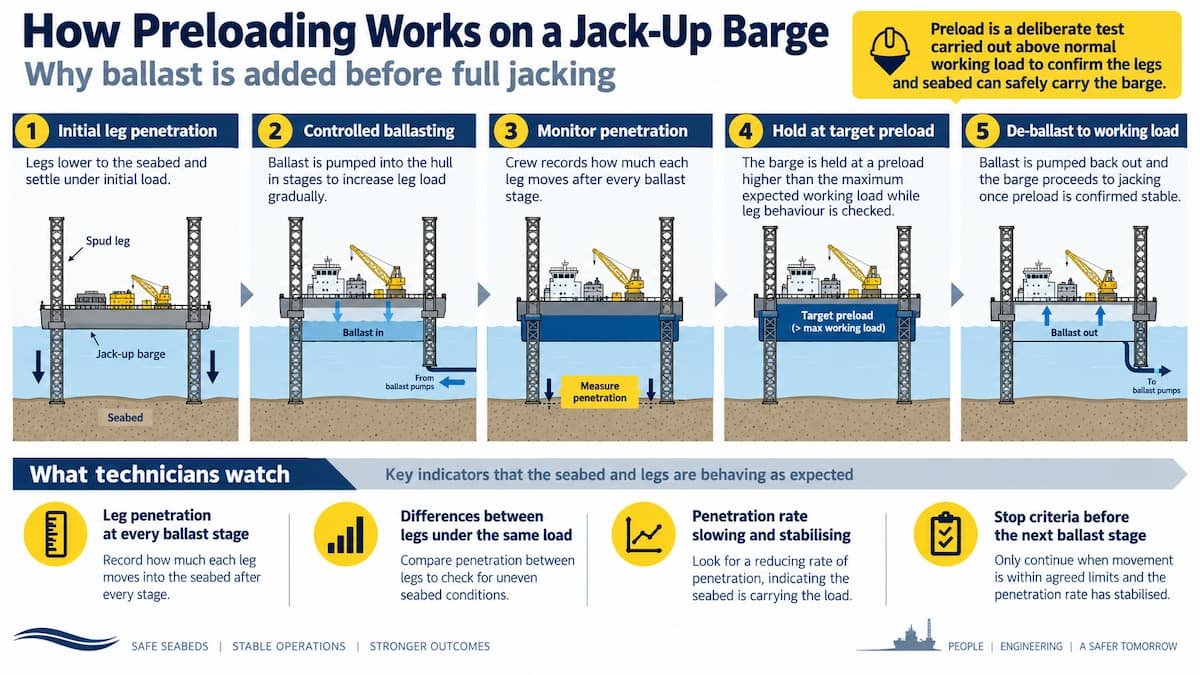
- Initial leg penetration. Legs lower under their own weight plus the weight already on them until they make firm contact with the seabed and penetration slows on its own.
- Controlled ballasting. The crew pumps ballast into the hull in stages rather than all at once, increasing the load on the legs step by step rather than applying full preload immediately.
- Monitoring penetration at each stage. After each ballasting step, the crew records how far each leg has moved and compares it against the previous reading, watching for a penetration rate that’s accelerating rather than settling.
- Holding at target preload. Once ballast reaches the target preload level, set deliberately above the maximum load the legs will see during actual work, the crew holds that load for a period and confirms penetration has stopped or is settling to a steady, acceptable rate.
- De-ballasting back to working load. With preload confirmed successful, ballast is pumped back out until the hull returns to its normal working weight, and the barge proceeds to full jacking.
The staged approach matters because it gives the crew a chance to stop. Applying full preload in a single step removes the early warning that a gradual, monitored increase provides.
Reading the signs of punch-through before it happens
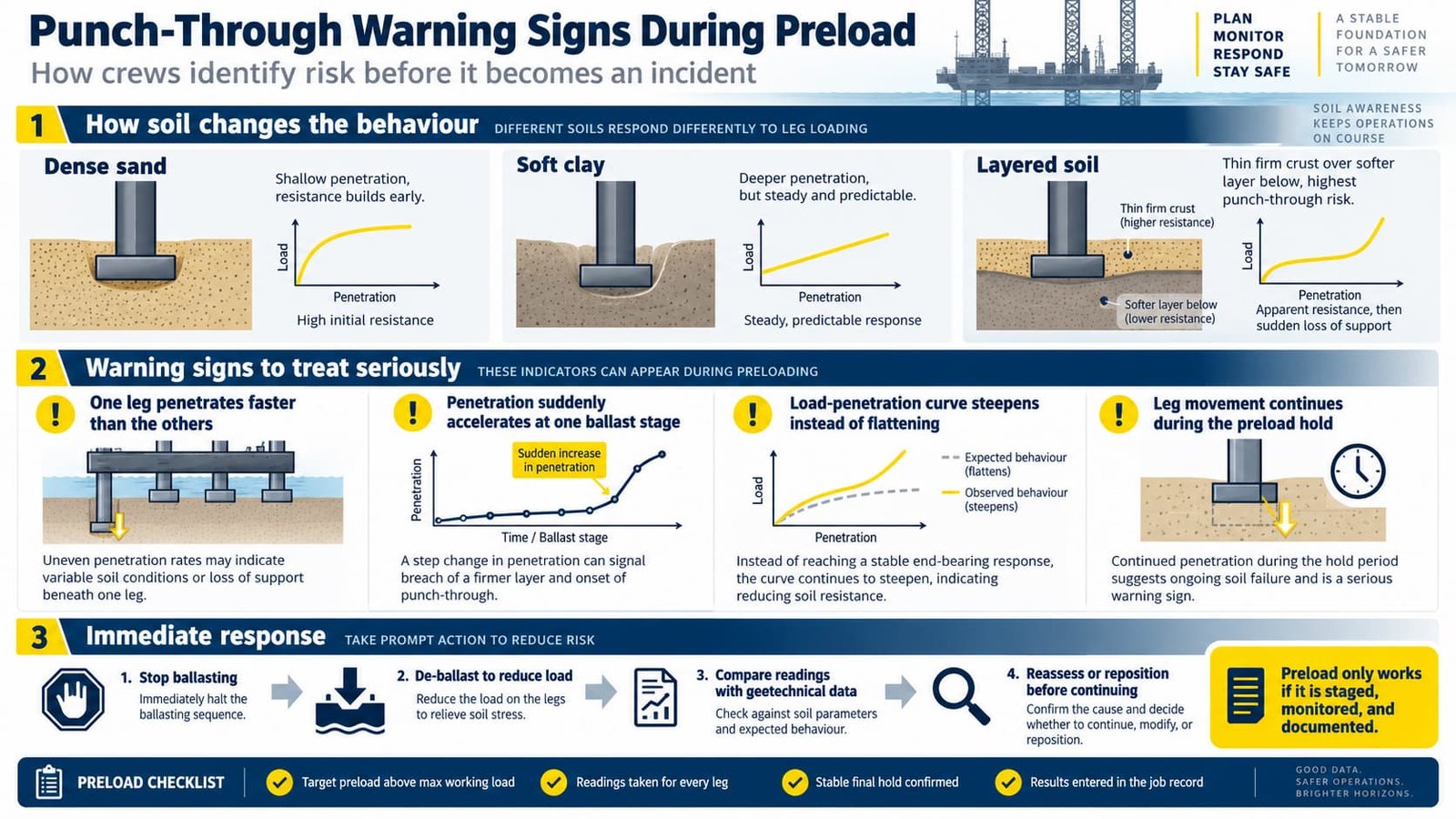
A load-penetration curve, which simply plots how far a leg has sunk against how much load has been applied at each stage, is the main tool here. A healthy curve flattens as load increases, meaning the soil is resisting more effectively the deeper the leg goes. A curve that stays flat and then suddenly steepens is the classic signature of a leg approaching a weak layer underneath a stronger crust.
Other signs worth treating seriously include one leg penetrating noticeably faster than the others under the same ballast stage, since legs in similar soil should behave similarly, and any sudden jump in penetration rate at a specific ballast stage rather than a smooth progression. None of these alone proves punch-through is happening, but any of them is reason to pause ballasting and reassess rather than continue to the next stage on schedule.
What to do when preload doesn’t go as planned
Even with good preparation, preload sometimes reveals a problem. How the crew responds at that point matters as much as the monitoring that caught it.
If one leg penetrates faster than the others
Stop ballasting immediately rather than continuing to the next planned stage. Compare the affected leg’s readings against the available geotechnical data for that specific spot, since even a few metres of lateral distance can mean different soil conditions on a site with known variability. If the discrepancy can’t be explained by expected soil variation, de-ballast and reposition rather than pushing forward on the assumption it will settle out.
If penetration suddenly accelerates during a hold
This is the clearest punch-through signature, and the correct response is to de-ballast immediately to reduce load on the legs before penetration continues further. Once the load is reduced and the situation is stable, the crew needs to reassess the site, which may mean consulting updated geotechnical data, repositioning the barge, or adjusting the planned preload target based on what the failed attempt revealed about the actual soil profile.
Documenting the preload for the record
Every preload stage, its ballast level, and the corresponding leg penetration readings should go into the job record, not just a verbal confirmation that preload succeeded. This record matters for two reasons. It gives the next crew working the same site real data on what that specific location’s soil actually does under load, and it provides the documentation a classification society or client inspection may ask to see after the job.
A preload monitoring checklist
- Geotechnical data reviewed for this specific location, not just the general site
- Preload target confirmed above the maximum expected working load on the legs
- Ballasting planned in stages, not applied as a single step
- Leg penetration recorded at every ballast stage, for every leg
- Stop criteria agreed before starting, so the decision to pause isn’t made under pressure
- Final preload hold confirmed stable before de-ballasting to working load
FDC’s fleet, including AQUAQUEEN, AMIT, PRIDE 1, SANGAM 2 and AQUASTAR, carries leg and jacking system documentation maintained through its in-house shipyard in Belapur, Navi Mumbai, and crews familiar with preload conditions typical to Mumbai’s harbour and coastal sites. For technical queries on a specific vessel or job, call 98677 00755 / 93218 44408 or email famous2131@gmail.com.