How does a jack-up barge work? A technician’s guide to the jacking system
Published on September 20, 2026 by Famous Dredging Corporation
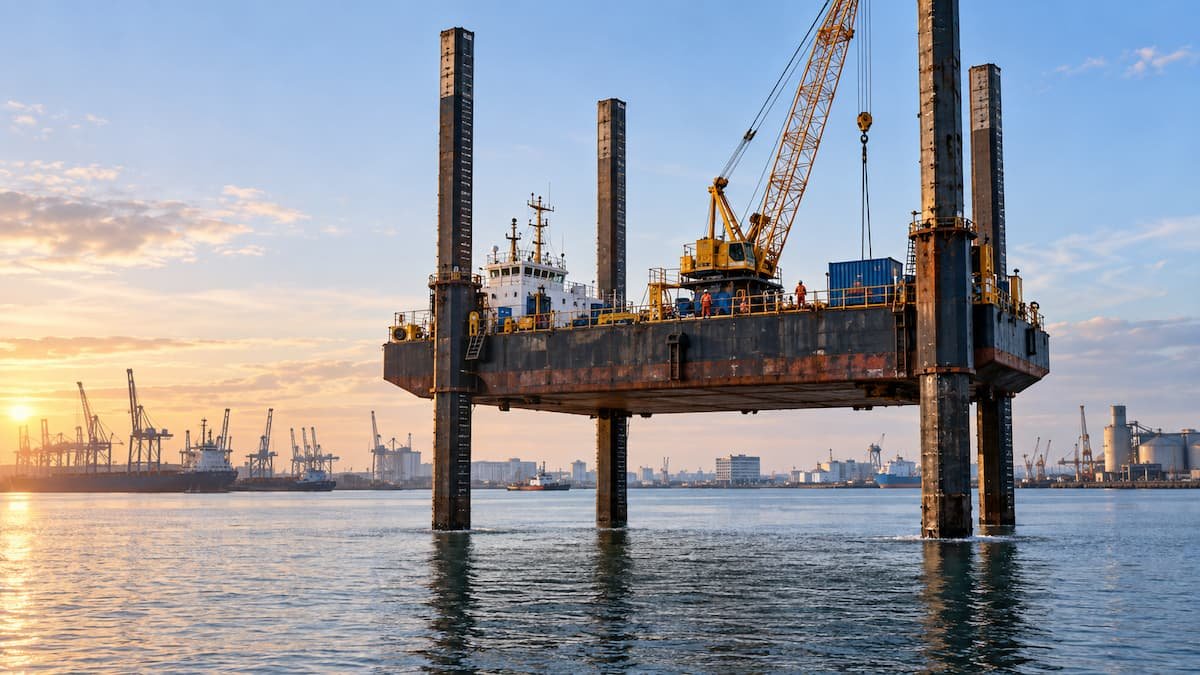
A jack-up barge only looks calm once it is standing on its legs. Getting it there is the part that separates a routine mobilisation from a serious incident, and most of what goes wrong happens in the few hours between the legs touching the seabed and the hull clearing the water.
This guide is written for the people who actually run that process: barge crew, site engineers and technicians working on marine construction, dredging support and harbour projects. It explains how the jacking system physically lifts a barge clear of the water, walks through the elevation sequence stage by stage, and covers what to check before and during a jacking operation.
If you’re reviewing FDC’s own fleet before a job, our jack-up barge fleet page lists current specifications for AQUAQUEEN, AMIT, PRIDE 1 and the rest of the units.
What a jack-up barge actually is
A jack-up barge is a floating hull fitted with movable legs. During transit, the legs sit raised above the hull and the unit behaves like any other barge, riding on buoyancy alone. Once it reaches the work site, the legs lower until they reach the seabed, and the jacking system then pushes the hull upward along the legs until it clears the water entirely.
That last part is what makes a jack-up different from a conventional pontoon or flat top barge. A pontoon stays afloat throughout a job, so it still moves with waves, current and tide.
A jack-up barge, once elevated, is effectively a fixed platform standing on the seabed. Waves pass underneath it instead of moving it, which is exactly why the technique exists: it gives you a stable working deck in conditions where a floating barge would be too unsteady for piling, crane work or precision fabrication.
The components that make elevation possible
Every jack-up barge relies on the same basic set of parts, even though the scale and design vary between a small harbour unit and a large offshore platform.
| Component | What it does |
|---|---|
| Hull | Provides buoyancy during transit and houses equipment, machinery and, on larger units, accommodation |
| Legs (spuds) | Tubular or lattice structures, usually 3, 4, 6 or 8 per barge, that transfer load down to the seabed |
| Spud can | A widened footing at the base of each leg that spreads the load over a larger area, reducing how far the leg penetrates the seabed |
| Jack house | The structure at each leg position on the hull that contains the jacking mechanism |
| Jacking system | The mechanism, hydraulic or rack and pinion, that moves the hull up and down the legs |
| Ballast system | Tanks and pumps used to control trim and to add controlled weight during preloading |
| Control cabin | Where the operator synchronises jacking across all legs and monitors load and tilt readings |
How the jacking system actually lifts the platform
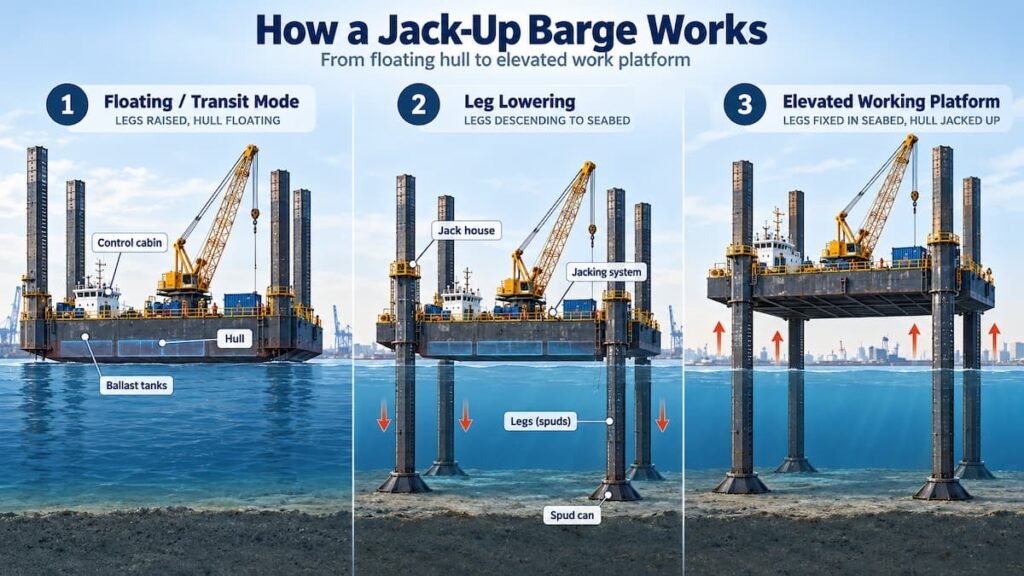
Two mechanisms account for most jack-up barges in service. The first is a hydraulic pin and cylinder system, sometimes called a climbing jack.
Hydraulic cylinders grip pinholes along the leg, extend to push the hull up a fixed increment, release, reset lower, and grip again, much like a person climbing a ladder hand over hand. It’s mechanically simple, which is one reason many modular jack-up barges use it.
The second is a rack and pinion system, more common on larger offshore units. Motor-driven gears mesh with a rack running the length of the leg and rotate to drive the hull up or down continuously, rather than in steps. It moves more smoothly but adds mechanical complexity and cost, so it tends to appear on bigger platforms where that trade-off makes sense.
Either way, the principle is the same. The legs stay fixed once they’re planted on the seabed, and the jacking system moves the hull relative to them, not the other way round.
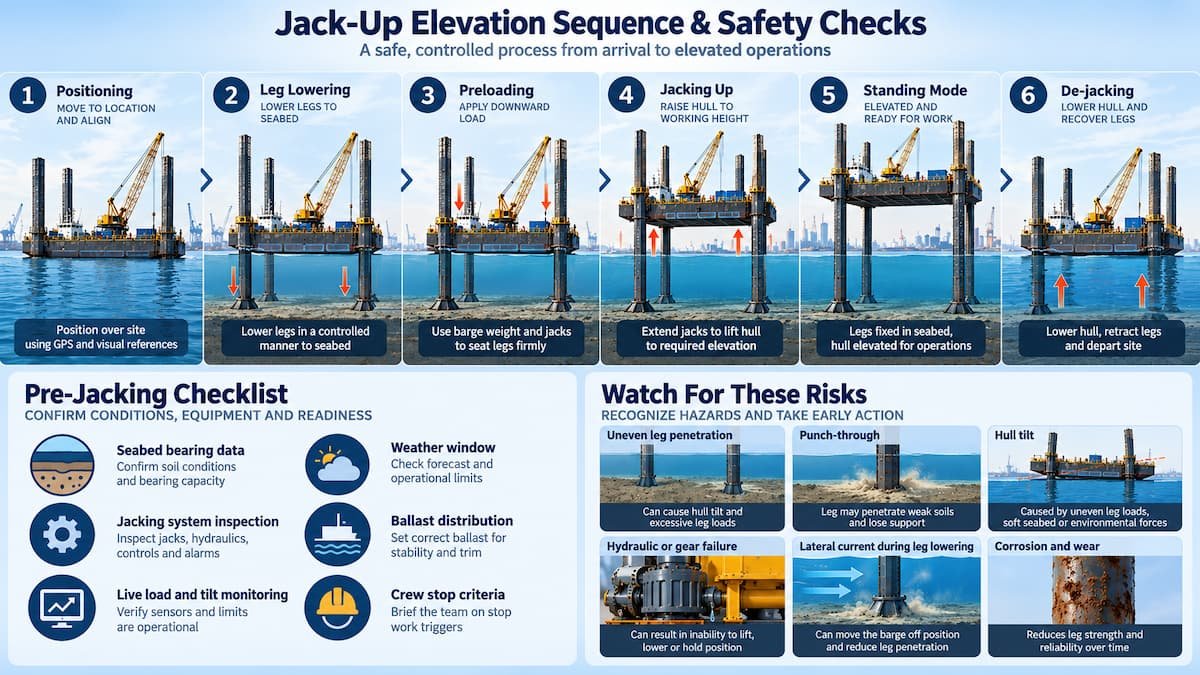
The elevation sequence step by step
- Positioning. Tugs move the barge into place and hold it on location while the legs are still raised.
- Leg lowering. The legs lower until the spud cans reach the seabed. How far they penetrate depends entirely on the soil. In dense sand, a leg might stop within a shallow depth. In soft harbour mud, the same leg can sink much deeper before it reaches a layer firm enough to bear load.
- Preloading. Before committing full weight to the legs, the crew pumps additional ballast into the hull to simulate the maximum load the legs will carry during the job. This is deliberate over-testing: if a leg is going to punch through a weak soil layer, you want that to happen now, at low air gap, rather than later with the deck fully loaded.
- Jacking up. Once preload holds without excessive or uneven penetration, the jacking system raises the hull up the legs until it clears the highest expected wave crest for the operating window, with margin for tidal range.
- Standing mode. The barge now behaves as a fixed platform. Deck operations, whether that’s piling support, crane lifts or fabrication work, proceed as if on solid ground.
- De-jacking. To leave, the sequence reverses: the hull lowers back into the water, the legs retract, and the barge returns to floating mode for towing.
Getting the jacking operation right on site
Understanding the mechanism is one thing. Running the operation safely is another, and that comes down to a handful of checks before you start and a few things you watch closely once the legs go down.
Checks before you start jacking
- Confirm seabed bearing capacity from a survey or previous data for that berth, since the same barge behaves very differently on sand, mud or rock
- Check the weather window against your barge’s stated wave height and wind limits, since jacking in swell puts impact loads on the legs before they’ve found a stable footing
- Pressure-test the hydraulic system if it’s a climbing jack unit, or check gear and motor condition on a rack and pinion system
- Verify ballast is distributed to keep the hull level before you begin lowering the legs
What to monitor once jacking begins
Leg load readings and tilt indicators are your early warning system. All legs should show a similar penetration rate as they go down.
If one leg penetrates noticeably faster than the others, that’s often the first sign it has found a weaker soil layer, and it’s the point to stop and reassess rather than push through and hope it settles.
A sudden, uncontrolled drop in one leg during preload is a punch-through, and it’s exactly what the preload stage exists to catch before the deck carries real weight.
Jack-up barge vs modular jack-up barge: what changes on site
A conventional jack-up barge has its legs permanently fitted to a single hull, so it’s ready to work as soon as it arrives. A modular jack-up barge is assembled on site from separate pontoon sections bolted or pinned together, with legs added afterward.
That first assembly takes longer, but it means the unit can reach sites with restricted access, narrow channels or limited berth space that a single large hull couldn’t get into. It also means the deck configuration can change between jobs by adding or removing pontoon modules. We’ll cover this comparison in more depth, including deck load and mobilisation trade-offs, in a separate guide.
Where things go wrong
Most jack-up incidents trace back to a small set of causes. Punch-through remains the most serious, where a leg breaks through a firm crust into a much softer layer underneath, faster than the preload stage anticipated. Uneven preload across legs, often from ballast not being distributed evenly, produces tilt that gets worse as jacking continues.
Hydraulic leaks can halt a climbing jack system mid-lift, leaving one leg out of sync with the others. Lateral current during leg lowering can also damage a leg before it even reaches the seabed. In Mumbai’s saline harbour conditions specifically, corrosion on jacking pins and rack teeth accelerates faster than in fresh water, which is one more reason inspection intervals matter more here than the manufacturer’s default schedule might suggest.
Keeping the jacking system in working order
Routine inspection should cover pin and rack wear, hydraulic fluid condition, and the structural condition of the legs themselves, since dents or corrosion reduce how much load a leg can safely carry.
Load cell and tilt sensor calibration deserves the same attention, because a jacking operation is only as safe as the readings the crew is trusting. Beyond routine inspection, follow your vessel’s classification society survey cycle for the jacking system and legs, not just the hull.
A quick pre-jacking checklist
- Seabed bearing data confirmed for this specific berth
- Weather window checked against wave height and wind limits
- Hydraulic or rack and pinion system inspected and pressure-tested
- Ballast distributed evenly before leg lowering begins
- Leg load and tilt monitoring live and confirmed working
- Stop criteria agreed with the crew before jacking starts, not during it
FDC’s own fleet includes both conventional jack-up barges like AQUAQUEEN and modular units including AMIT, PRIDE 1, SANGAM 2 and AQUASTAR, supported by an in-house shipyard in Belapur, Navi Mumbai for repairs, modifications and jacking system maintenance. For charter availability or technical specifications on a specific vessel, call 98677 00755 / 93218 44408 or email famous2131@gmail.com.