Jack-up barge vs modular jack-up barge: What actually sets them apart
Published on September 21, 2026 by Famous Dredging Corporation
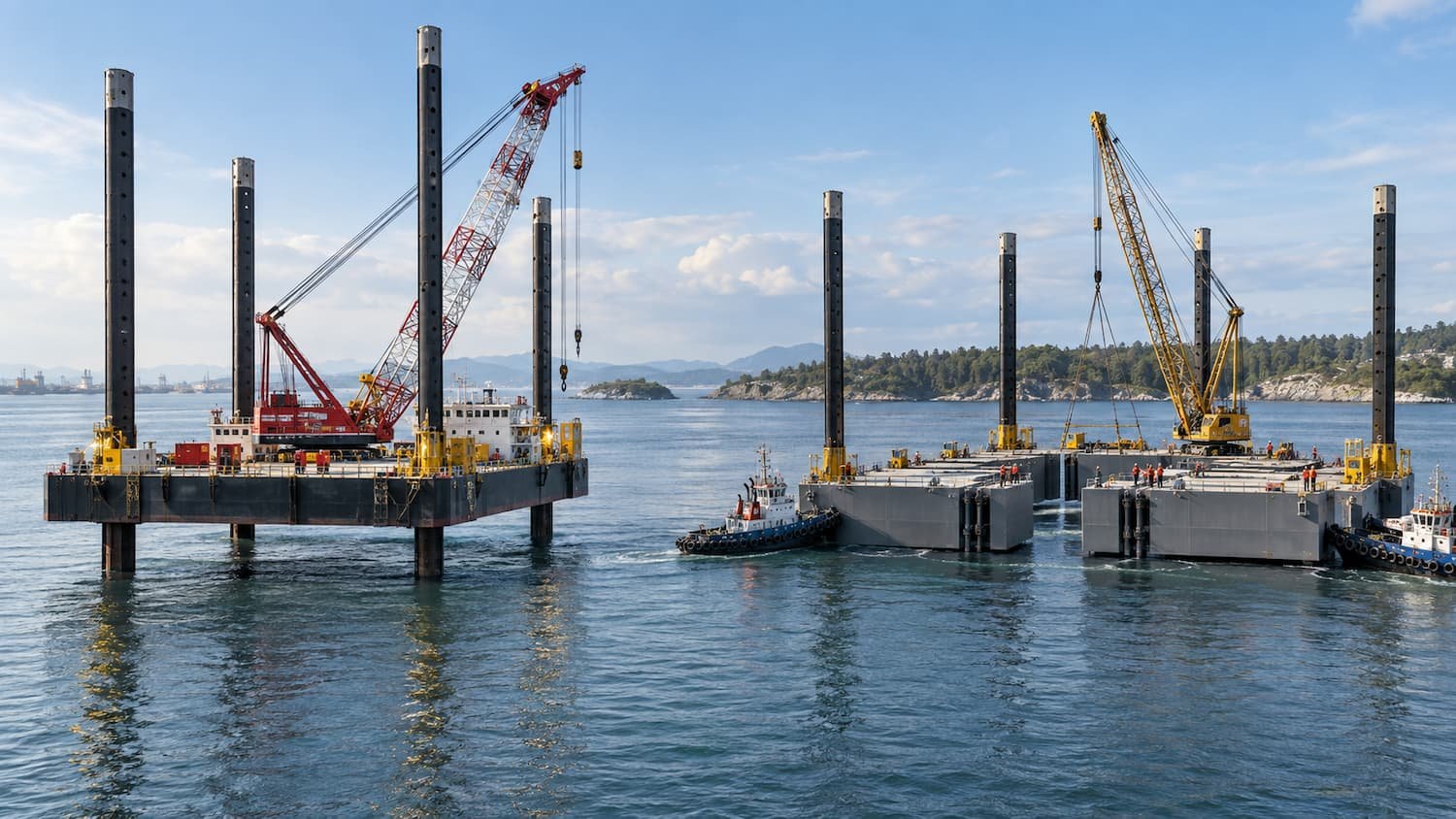
Jack-up barge vs Modular jack-up barge: Two barges can both be called jack-up barges and still be built in almost opposite ways. One arrives as a single hull with its legs already fitted. The other arrives in pieces, gets pinned together on site, and only becomes a working platform after that assembly is complete and checked.
Mistaking one for the other on a work plan causes real problems. A schedule that assumes a conventional jack-up’s readiness will run late if a modular unit turns up instead, and a site with restricted access will reject a monohull that a modular barge could have reached in sections. This guide sets out what actually differs between the two, from hull construction through to the structural checks a technician needs to run before either one goes to work.
For background on how the jacking mechanism itself operates once a barge is standing on its legs, see our guide on how a jack-up barge works.
What separates a jack-up barge from a modular jack-up barge
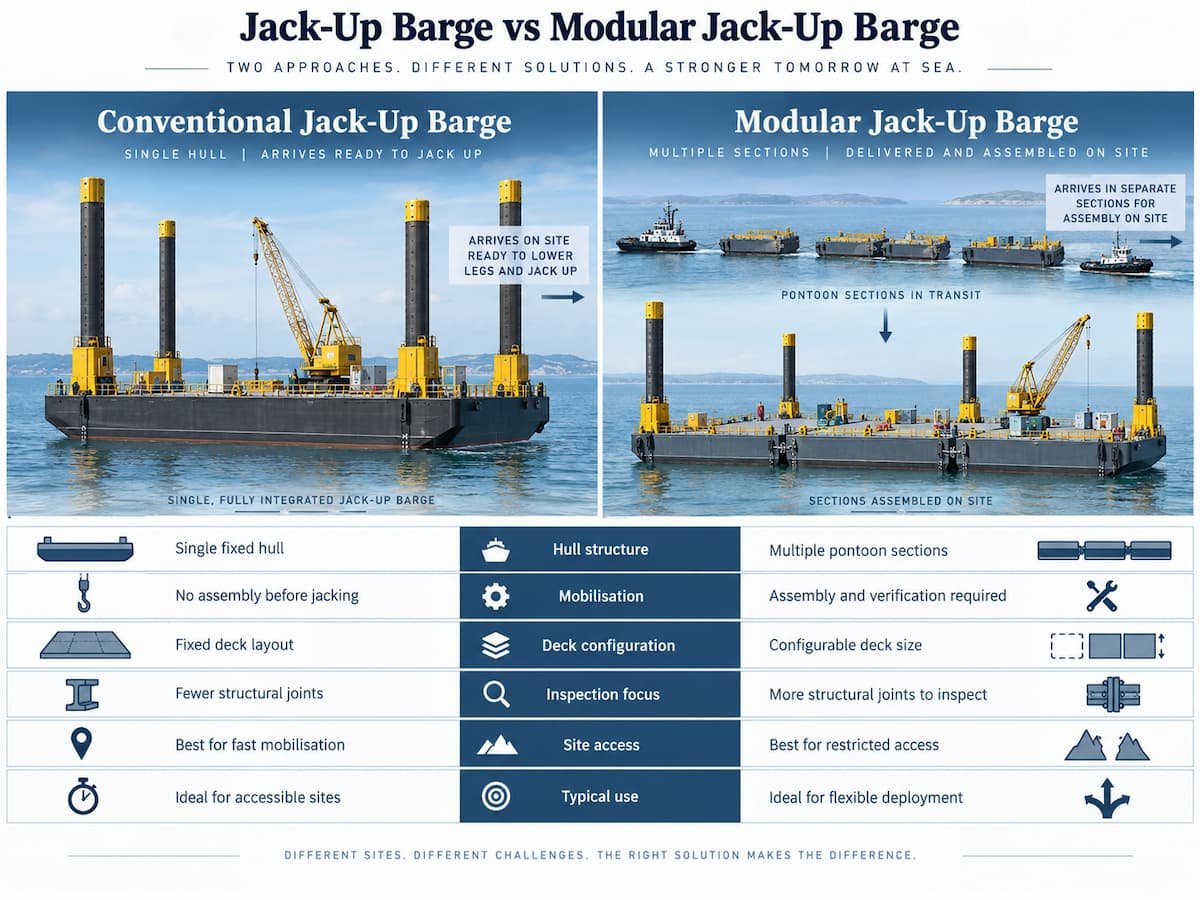
A conventional jack-up barge is built as one continuous hull, with legs and jacking systems fitted during construction and never removed. It arrives at a site ready to lower its legs and jack up, with no assembly step in between.
A modular jack-up barge is built from separate pontoon sections, each one a self-contained buoyant unit, that get connected on site using pins, bolts or a combination of both. Legs and jacking systems are often fitted to the assembled unit rather than to individual modules, though some designs mount jacking systems on specific corner sections. Once connected and checked, the modular unit functions exactly like a conventional jack-up barge for the rest of the job.
So the difference isn’t in what the barge does once it’s standing. It’s in how the barge gets to that standing configuration in the first place.
Hull construction: Monohull vs pontoon sections
A monohull jack-up barge is a fixed structure. Its dimensions, deck layout and leg positions are set at build time and don’t change between jobs. That fixed design means fewer structural joints, which means fewer places for fatigue cracking or connection wear to develop over the barge’s working life.
A modular barge trades that structural simplicity for flexibility. Each pontoon section connects to its neighbours through pin joints or bolted flanges, and those connections carry real structural load once the unit is jacked up and working. That’s the trade-off in one sentence: a monohull gives you fewer parts to inspect but no flexibility in size, while a modular barge gives you configurable deck area but adds structural connections that need their own inspection regime.
How a modular jack-up barge actually gets assembled
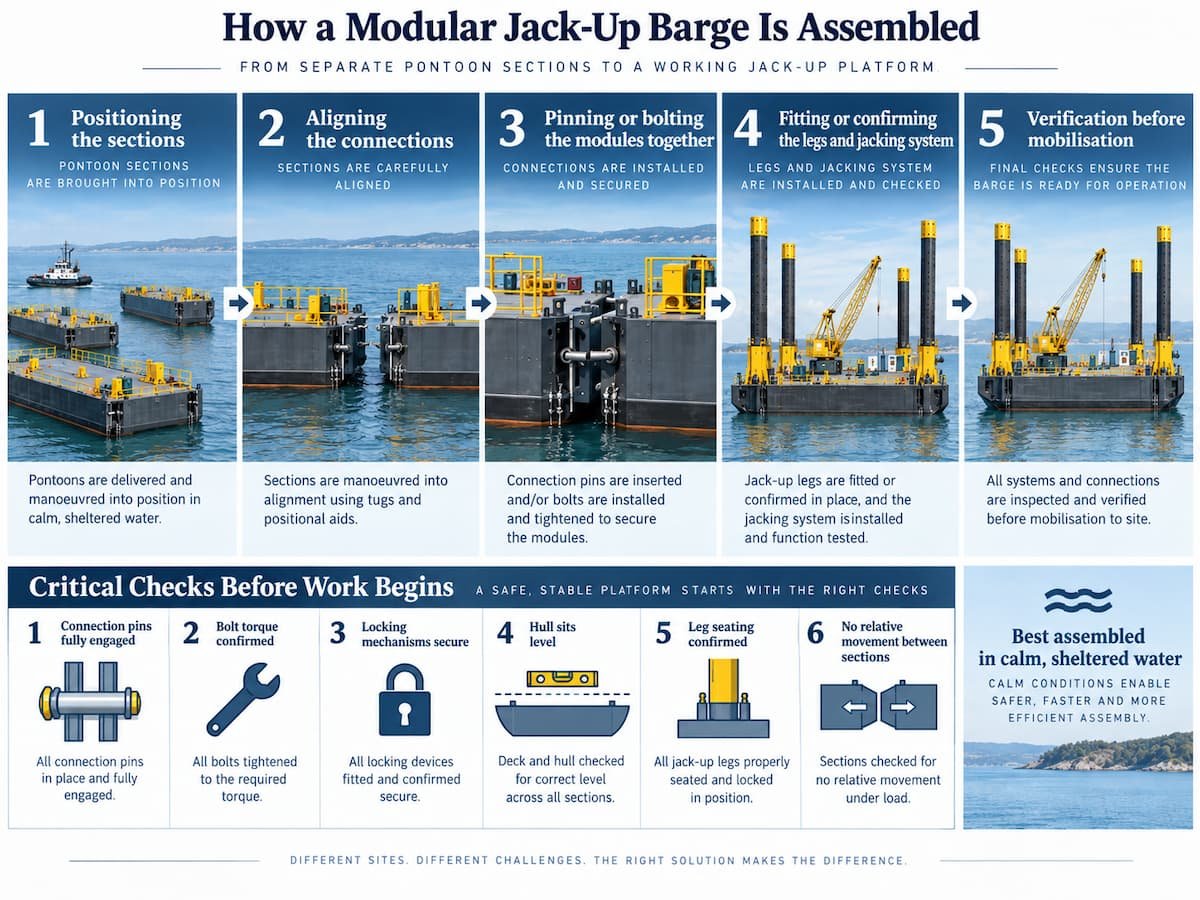
Assembly usually happens in calm, sheltered water rather than at the final work site, since alignment tolerances on the connecting pins are tight and any swell makes that alignment harder to achieve safely.
- Positioning the sections. Tugs bring each pontoon module alongside the others in the planned configuration, guided by fender systems or temporary lines to hold rough alignment.
- Aligning the connections. Crews align pin sleeves or bolt holes between adjacent sections, often using guide cones or tapered pins to bring rough alignment into precise alignment.
- Making the connection. Pins are driven home or bolts torqued to specification, and on some designs a secondary locking mechanism secures the primary connection against vibration loosening it over time.
- Fitting or confirming the legs. Depending on the design, legs are either already mounted on specific modules and simply confirmed as seated correctly, or fitted to the assembled unit at this stage.
- Verification. Before the unit moves to its work location, the crew checks that every connection is fully engaged and that the assembled hull sits level, since an uneven assembly puts uneven load on the legs the moment jacking begins.
None of this is fast. Assembly typically adds a mobilisation step that a monohull simply doesn’t need, and it’s worth planning for in any schedule that specifies a modular unit.
Jack-up barge vs Modular jack-up barge: Jacking system differences
| Factor | Conventional jack-up barge | Modular jack-up barge |
|---|---|---|
| Hull structure | Single fixed hull | Multiple pontoon sections joined on site |
| Mobilisation before jacking | Legs lowered directly, no assembly needed | Sections must be assembled and verified first |
| Deck configuration | Fixed at build time | Adjustable by adding or removing modules |
| Structural joints to inspect | Minimal, mainly leg and jack house connections | Leg and jack house connections, plus every inter-module joint |
| Site access | Limited by the hull’s fixed dimensions | Sections can transit narrow channels separately |
| Typical use case | Repeat jobs at accessible sites needing fast turnaround | Restricted-access sites or jobs needing a non-standard deck size |
What the construction difference means for fieldwork
The mechanical distinction above translates directly into how each barge behaves on a real job, and this is where it matters most for the crew actually running the operation.
Mobilisation time and site access
A conventional jack-up barge wins on speed to first jack-up, since there’s no assembly step to complete before the legs go down. That makes it the better choice for jobs where the barge needs to be operational quickly, or where it moves between several nearby sites in succession.
A modular barge earns its keep on access. Individual pontoon sections often have a shallower transit draft and a smaller footprint than an equivalent single hull, which means they can reach a berth or channel a monohull physically can’t enter. FDC’s fleet reflects this split directly: AQUAQUEEN operates as a conventional jack-up barge, while AMIT, PRIDE 1, SANGAM 2 and AQUASTAR are modular units built for exactly this kind of flexible deployment.
Deck load and configuration flexibility
Because a modular barge’s deck area comes from however many sections are connected, its usable deck load and layout can change between jobs in a way a monohull’s can’t. Adding a section increases both deck area and buoyancy, which is useful when a job needs a bigger working platform than a single hull would provide.
That flexibility comes with a technical catch. Total deck load capacity on a modular unit depends on the combined structural rating of the assembled sections, not just the strength of any one module. A technician planning a heavy lift on a modular barge needs the assembled unit’s rated capacity, not the rating of an individual pontoon section considered on its own.
Structural connections and what to inspect
The inter-module connections on a modular barge carry genuine structural load once the unit is jacked up, so they need their own inspection routine separate from the leg and jacking system checks covered in our jacking system guide. Pin wear, bolt torque retention and any sign of relative movement between sections all matter here, since a connection that’s loosened slightly under cyclic loading can allow flexing that a monohull’s welded structure simply doesn’t experience.
A conventional jack-up barge avoids this category of inspection entirely, because it has no equivalent joints. Its structural attention goes almost entirely to the legs, jack houses and hull plating, the same checks covered for any jack-up unit.
Maintenance planning across the two types
Maintenance intervals for the jacking system, legs and hull plating are broadly similar between the two barge types, since both rely on the same underlying jacking mechanisms once assembled. The real difference sits in the additional connection inspection a modular barge requires, and in the fact that a modular unit’s individual sections can be pulled out of service and swapped or repaired without taking the whole barge out of rotation, something a monohull can’t do.
Jack-up barge vs Modular jack-up barge: Choosing the right type for the job, from a technical standpoint
Use a conventional jack-up barge when the site is easily accessible, the deck requirement is standard, and fast mobilisation matters more than configuration flexibility. Use a modular jack-up barge when the site has restricted access, when the job needs a deck size that doesn’t match a standard hull, or when individual sections may need to be serviced or swapped without losing the whole unit.
Neither type is inherently the safer or stronger option. Each does its job well within the conditions it was designed for, and most of the risk in either case comes from skipping the inspection steps specific to that barge’s construction, not from the construction type itself.
FDC operates both types from its Mumbai base, with an in-house shipyard in Belapur, Navi Mumbai handling structural inspection, connection maintenance and jacking system repairs across the fleet. For technical specifications on a specific vessel or to discuss which type suits a project, call 98677 00755 / 93218 44408 or email famous2131@gmail.com.